You become the product of your environment. If you hear "you're not good enough" or "you haven't earned success," then extra obstacles stand in your way.
"You make your habits and your habits make you." James Clear, author of Atomic Habits, says that habits are votes for the type of person you want to become.
Want to be in great physical condition? Exercise.
Want to be an exceptional student? Have a better study process.
Want to write better? Write intentionally every day.
Jon Gordon wrote "The Positive Dog" about the power of positivity. Work on becoming a more positive version of yourself.
Take care of your 'academic' business. Thrive don't survive.
Set the standard at practice; punctuality and effort drive performance.
Follow all team rules - including chemical health.
Take care of yourself - hydration, sleep, nutrition, recovery. The first sign of dehydration isn't thirst, it's fatigue.
Prepare psychologically for adversity.
Injury can happen. Maintain strength and conditioning.
Respiratory illnesses are always around. Immunizations are between your family and your doctor.
Players have slumps. Believe in yourself.
Mindfulness helps focus, anxiety, depression, and reduces circulating stress hormones.
Volleyball is a game of momentum. Focus helps prevent negative runs. Commit to a "next play" mentality.
Every competitor experiences butterflies, because they care. Adrenaline drives feeling nervous, making you quicker and stronger.
Every player has hiccups during a match. In "Golf Is Not a Game of Perfect," Dr. Bob Rotella shares that top pros expect six to seven "bad shots" a round. They're ready to move on. One of the lessons learned from Stoicism is that you can't control what happens to you but can control your response. Do not allow the last play to interfere with your execution this play.
Three mistakes players can make are:
1) Deviating from the present, contemplating victory.
2) Thinking about body mechanics and tempo instead of playing.
"It's not the size of the dog in the fight, it's the size of the fight in the dog."
Success never comes easily or without a price.
Regardless of whether you're the tallest or the most athletic, you can find a place if you pay the price to hunt success.
Ask yourself what that would look like for you. Carve out a role through skill and will. As Coach Bob Knight said, "It's not the will to win, it's the will to do whatever it takes to prepare to win."
Our lives are stories. Sara Blakely, founder of SPANX, explained that at dinner each Saturday, her father asked, "What have you failed at this week?" Success demands that we leave our comfort zone.
That means doing studying five more minutes, doing five more reps, understanding that "champions do extra."
You haven't seen your coaches watching college volleyball, studying film, or scouting opponents before playoff games. The unrequired work separates excellent from good.
Your coaches want you to experience what your MVB 'predecessors' have known.
All opinions expressed in this blog are solely mine. This blog is not an official publication of any City of Melrose institution.
Underrated leadership hack: Repeat yourself. Almost no one hears you the first time. Your team is focused, driving, and probably overwhelmed. Say it once and they miss it. Say it ten times and they'll hear it for the first time. Repetition isn't boring. It's strategic clarity.
"Repetitions make reputations." Coaches don't repeat themselves because we like to hear ourselves talk. "If it has not been learned, then it hasn't been taught."
Here are phrases or quotes that can help you:
1. "Sacrifice." Put the team first. Be an early adopter of "How can I help?"
2. "Anything that a coach tells you shares the lesson for everyone else on the team." Everyone makes mistakes. Good players and good teams stop repeating them.
3. "Do the dirty work." That's literal as "get on the floor" and figurative as in "leave the gym better than you found it."
4. "Everyone benefits from coaching." - Rams Coach Sean McVay
5. "Promise yourself to make one better choice today."
6. "Do five more." - Dan Pink (Study five more minutes, do five more repetitions, read five more pages).
7. Praise a teammate who did something well. "Catch people in the act of doing something right."
8. "Eat that frog." Do first the hard thing that you don't want to do.
9. Make gratitude a skill. Thank your parents, a teacher, or a coach. Everyone wants to be valued and appreciated.
10."I can't think for everyone." - Bill Parcells Think critically. When your parent says, "If all your friends say they're going to do something stupid, will you?"
Lagniappe. Better communication separates excellent from good. Analogy help us to connect concepts across domains. Challenge yourself to think better and to improve your writing.
Lagniappe 2. Become more versatile as a player and as a thinker. There's a southern expression, "Bless your heart" which varies from extreme praise to withering criticism.
"Success is a choice." What qualities belong to those you admire? Can you apply them?
A teacher had an unruly, undisciplined and disrespectful class. She had an idea to improve their self-esteem.
She gave each student (teammate) a paper with the name of all the class and asked each to write two things that they admired about a classmate.
She then cut and pasted the comments onto a sheet for each student, so they had a big sheet of positives about themselves.
She witnessed a remarkable transformation as the students' self-esteem and self-control rose.
Many years later she passed away and many of the students came to her funeral. Many brought a wrinkled, faded paper from that class with the positive observations of classmates.
We choose to lift people up or do something else - "success or less."
Become a storyteller. Develop a portfolio of stories to lead others up, especially when an individual or group needs it most.
Everyone wants to be valued, appreciated for who they are and what they bring to the team.
MVB has many stories wroth telling:
In 2005, Melrose played Burlington, a team which had three boys at least 6'3" who by rule, could only play the back row. Coach Scott Celli said that they could play all positions. MVB won anyway in straight sets, one win on their march to their first State Finals.
In 2010, a young team had a panoply of sophomores who led them to a Sectional Title, then a Finals in 2011, and a State Title in 2012.
In 2023, Sadie Jaggers led MVB to a playoff win despite playing out of a "sickbed" with a respiratory illness. Her performance was the MVB version of the "Jordan Game" where he led the Bulls to a Championship despite illness.
Legend recognizes the "big hitters" in sport. Josh Gibson, called the "Black Babe Ruth," was alleged to have hit a 480 foot homer at age 18.
Throughout sports - golf, football, and volleyball - big hitters develop a mystique that transcends mere mortals.
Melrose had its share of big hitters - players whose attacks left home fans and opponents hearing a "different" irreproducible sound, sonic booms. A few who immediately come to mind were Erin Hudd, Karen Sen, and Laura Irwin.
That doesn't mean the "big hitters" were more effective than more strategic hitters like Hannah Brickley, Victoria Crovo, or Sarah McGowan who could deliver the fastball or a panoply of secondary pitches.
Generate joy from scoring points, not from inducing fear in defenders. Develop craft not kilometers/hour to score on tips, rolls, cut shots, wiping blocks with placement, and even back sets that leave lasting legacy.
In the offseason:
Work on your craft
Understand the game better, especially your reads
Boost your athleticism - verts, quickness, power
Mind your mindset - become unstoppable
Lagniappe. We have to deal with the "elephant in the room." Whatever that may be. Don't survive. Thrive.
We’re wired to survive, not to thrive, and that means our brains lean heavily toward the negative. Neuroscience shows the most effective way to deal with that is simple: call it out.
You don’t remove the elephant in the room by pretending it isn’t there or telling people not to… pic.twitter.com/nIjhCRDyS8
Chade-Meng Tan wrote the book "Search Inside Yourself" as an extension of a mindfulness program he operated at Google. The book has broad applicability for everyone.
Three key outcomes available through mindfulness are:
1) Promoting stellar performance
2) Training exceptional leadership
3) Creating conditions for happiness
We can't control that much in life, especially how others treat us. But we can train ourselves to "widen the space" between events and our response. Rather than respond immediately and negatively, answer in a more thoughtful and nuanced way.
Remember the acronym "THINK"
T - Is it truthful?
H - Is it helpful?
I - Is it inspiring?
N - Is it necessary?
K - Is it kind?
There's some overlap here with Ruiz's "The Four Agreements"
1) Be impeccable with your word (even to ourselves)
2) Don't take anything personally? (What people say isn't always true)
3) Don't make assumptions. (We seldom know others' circumstances.)
4) Always do your best. (Silence is often a great choice.)
Mindfulness can help you work on your "volleyball character" - how you compete, discipline yourself, bring energy, lead, treat others, and respond to adversity (which visits everyone).
Lagniappe. An opponent rips an ace. Keep your "lioness mind."
“Just enjoy the process. Let your kids get better every single day, let them work on their craft. Understand that the lessons that they’re learning through sport are not just about the sport itself but are about life and how they develop as people,” Kobe Bryant pic.twitter.com/cPVKBySvc4
Exceptional teams share unusual trust. Belief in each other is a 'force multiplier', expecting teammates to make the correct read and to execute the play.
Trust gets you on the floor, keeps you on the floor, and helps you perform at the highest level possible. Trust flows from both measurables (skill and consistency) and intangibles - commitment, aggressiveness, energy.
"My concern is that the player has a plan, that he believes in the plan, and that he follows the plan." - Dr. Bob Rotella in Golf Is Not a Game of Perfect
Most players and teams are not so overpowering that they can "roll the balls out there and play." That means that teams and players need a "game plan."
Twenty plus years ago, North Andover's short game gave MVB some problems during the regular season. When they met again in the Sectional Final, Melrose shut that down and dispatched them. The game plan, supplementing the talent, proved a difference maker.
You know that "positive scoring" results from dominant service, block-kills, and attacks. MVB 26 is unlikely to score as much from block-kills as a new team won't have the block party that Sabine Wenzel hosted. That doesn't mean the team should abandon aggressive blocking. There's no reason why the available talent in the middle and at the pins can't improve and become difference makers.
As for service, understand where service points arise:
Attacking seams and sidelines
Serving short (the risk/reward equation changes)
Identifying weaker receivers
Improving service float, velocity, or spin
It is a fool's errand to repeat a good process over and over and expect excellence. Offseason volleyball is your proving ground where "repetitions make reputations."
Every season 400-500 kills "graduate" and have to be redistributed. You have ideas where more will arise but often surprises emerge, players who step up as impact players. Coach Scott Celli doesn't have an opening day lineup "penciled in," because it's impossible to know who "kicks the door down."
Lagniappe. Warren Buffett shares an abundance of wisdom accumulated over almost a century..."the chains of habit are too light to be felt until they're too heavy to be broken."
This is great advice that I had the privilege to hear from Mr. Buffett at age 24. Other than my parents, no one has had as profound influence on me as has Warren Buffett.
Dr. Bob Rotella's "Golf Is Not a Game of Perfect" shares an abundance of lessons about the psychology of sport.
In one chapter he shares a conversation with the Spaniard, Seve Ballesteros. Ballesteros grew up poor, using hand-me-down or found clubs on courses where he caddied. He learned "shotmaking" and improvisation, finding joy in making shots, "putting the ball in the hole."
Later, after success on the Tour, he got bombarded with recommendations on perfecting his swing and lost joy for the game. The search for perfect shots and "playing safe" ruined the game for him.
Take joy in "playing the game," doing "what makes you you." Maybe your attack footwork is four steps not three. Don't question yourself during a match, just "do what the beast does."
Your 'formative years' involve growing your skill, your strategy (including volleyball IQ and 'reading the game'), physicality, and psychology. When you've reached a certain level of play and experience, it's more about "playing" than overthinking.
A big part of coaching is avoiding "over-coaching," making great the enemy of good.
If you already experienced a "big role" on the team, continue to do what made you successful. Sometimes there's part of your game that needs work. Work on that to transition from excellent to elite.
Few parts of sport challenge players more than "keeping it simple."
"Do more of what works and less of what doesn't."
"Do well what you do a lot."
"Believe in yourself.
Lagniappe. You are growing up in an AI world. AI shouldn't replace your creative and critical imagination. It should supplement it. Learning how to blend the human and tech world is critical. Always follow the rules of your institutions.
7. The "Rough Draft" Mimic
Prompt: "Human writing is rarely perfect. Rewrite this text to include minor imperfections that make it feel authentic. Use casual phrasing and parentheses for side thoughts. Make the tone slightly informal and approachable, as if writing a blog post…
Many of you are young players. Think about your "journey of discovery," seeking to understand what fashions success.
There's discussion about a rider, elephant, and path. How does the rider help the elephant navigate the path.
Reason (Rider) - what logic applies to the situation?
Emotion (Elephant) - how can I harness emotion?
Process (Path) - what is your process?
Drake Maye shares the value of going to the Pro Bowl, interfacing with some of the best in the game. It's not enough to put in the time. Excellence follows putting in the work, thinking through the process of excellence.
USWNT Coach Dawn Staley likes jigsaw puzzles. Her coaching vision includes assembling puzzles - every piece matters.
Yesterday, I saw two former players, Meg and Kiki. Both either completed their masters degrees or are finishing them.
Meg was a "glue guy," someone who always did the right things although she wasn't necessarily the most talent. Kiki was tough, a "dirt dog" who never shied away from being a "toughness enforcer."
Amos Alonzo Stagg was asked about his team. He said to give him twenty years and he'd be able to give a better opinion. If Meg and Kiki are representative, I'm good with that team.
Roster construction isn't only about finding people to fill roles. It's about finding good people who value working together and sacrifice. This Reddit article illustrates how Brad Stevens operates.
"Yet winning and losing is all around us. From the high school level on, athletes are prepared to win and they in turn convey to a larger public what it is to be a winner...Victory has very narrow meanings and, if exaggerated or misused, can become a destructive force. The taste of defeat has a richness of experience all its own." - Bill Bradley in "Life on the Run"
Sports at their best are art - a tapestry woven from individual threads into expansive and sometimes iconic design.
Image from ChatGPT Plus, a closeup of The Alexander Mosaic
Great performances, seasons, or careers are mosaics of both memorable and forgettable moments.
Most of us want to be 'winners'. Athletes repeat cycles - preparation, practice, competition, recovery and back again. Games are a small slice of the whole, the "tip of the iceberg."
A memorable moment of a triumphant game-winning attack or home run is but one tile in that career mosaic. The errors and losses have roles, too, filling "blank space."
In the context of a mosaic, we attach significance to moments, often far beyond their 'true' importance. The knowing wink from a coach or transitory praise becomes a tessera in life's mosaic.
Individual mosaic tile or 'tessera'
For the aspiring athlete, managing physical and emotional "transitions" after practice or competitions has vital importance. Both triumph and trials need perspective.
The math test '100' is one tile forming part of your course grade, your semester GPA. Thankfully, we don't get graded on every sentence, every message, every relationship, every game.
The athlete who navigates victory and defeat well, Bradley's "richness of experience" has a better chance to fashion a memorable career.
Merry Christmas!
Lagniappe. Even elite players struggle. Rafael Nadal found meaning in the "fight for better feelings."
Always use the techniques and advice of your current coach. If your club coach wants it done "this way," do it that way. This short video provides some tips (low, balance, hold)
If Coach Celli wants it done another way, do it that way, unless you discuss it with Coach Celli and can prove why another way works better for you.
General thoughts about passing (I am not a volleyball coach):
1) Footwork is vital when you have time. Sometimes you won't.
2) Platform should be applied away from the body.
3) You control how much force must be added or subtracted to the ball.
4) A good pass (high, middle, off the net) is better than trying for a great pass, leading to an "overpass" or "trapping the setter" against the net.
5) "One bad pass often leads to another."
6) Nobody is perfect with passing, attacking, setting, etc. Always "move on" to the next play. "What is done is done."
7) You can't always play the ball from the midline (body), so learn to pass from both sides of the body.
8) For the "tough" play, prioritize keeping the ball in play over trying to do too much.
"My belief is that we should maintain standards in all things that we would need accountability, dependability, and responsibility to attain. They should be standards that we would also need to lean into others for support, feedback, and help to achieve. That is the high standard that I am talking about – high but attainable." - Clint Hurdle in "Hurdle-isms"
"Standards" has become a popular term in sport and society. They arise in the context of:
Standards of conduct (behavior)
Standards of preparation
Standards of performance
Standards of teamwork
Think about standards not as "better" but "different." Exceptional players organize, study, prepare, and perform to different standards. This applies at home, in school, and in extracurriculars.
What are your standards as an individual and as a team?
What are you doing to meet and then to exceed them?
What can you do as a group to hold each other accountable to those different standards?
Do you have an accountability 'tool' to measure them? (E.g. a checklist)
Are you measuring, monitoring, or reviewing performance (e.g. cellphone video, analytics - hitting efficiency)?
"Do more to become more. Become more to do more." That's the line I use to describe "star in your role." Embrace your role while working to expand it.
Praise the praiseworthy. This blog is not the vehicle to "carry water" for players or to "throw them under the bus." Be the player with quality effort at practice and unfailing sideline support during games. Star in your role, setting an "effort standard."
NBA Hall of Fame Coach Chuck Daly had a line, "NBA players want three things - 48 minutes, 48 shots, 48 million." That distills to minutes, role, and recognition.
"You earn your paycheck." Coaches can only play six at a time. If you are driven to start, to play more, and have a big role, then it's on you to "force your coach to play you."
Don't just accept your role, embrace it while working to become worthy of a bigger one.
Lagniappe. Becoming your best.
Nine habits of highly successful athletes: 1. Showing up early 2. Listening to coaches 3. Working hard 4. Thinking positive 5. Putting the team first 6. Studying film 7. Eating healthy 8. Practicing rest and recovery 9. Going to sleep early
"Always do your best." - Don Miguel Ruiz, The Four Agreements
Lagniappe. Live to your standards and values.
Leadership isn’t about moods — it’s about values. When your decisions align with what you believe, you become the most consistent person in the room. This clip explains why consistency builds real influence. pic.twitter.com/k6wTHYx5CU
Stoicism found a home in sports, especially in volleyball, because it teaches poise under pressure. The game moves fast. Stoicism provides a framework to stay steady, present, and accountable.
I don't know enough about volleyball to coach, but I can consult on several areas, including physical and mental training.
What Is Stoicism?
The name comes from stoa, meaning porch. The early Stoics were literally “porch guys,” teaching in the shade of the Stoa Poikile in ancient Athens. The philosophy spread through remarkable figures such as Marcus Aurelius, an emperor; Seneca, a statesman; and Epictetus, a formerly enslaved man, later a renowned teacher.
The message: Stoicism is for everyone, the powerful and the powerless, the veteran and the role player. Everyone can practice Stoic habits.
What Do We Control?
The Stoics had one foundational question: What is actually in our control?
Their answer: our mind.
In volleyball terms, that becomes ACE,your Attitude, Choices, and Effort.
You don’t control the officials, the crowd, or bad bounces. But you can control:
your body language after an error
your communication with teammates
your footwork, discipline, and preparation
your willingness to work and learn
Author Ryan Holiday summarizes it this way:
“We control our opinion, choice, desire, aversion…everything of our own doing. We don’t control our body, property, reputation, position…everything not of our own doing.”
Matches often turn not on skill alone but on self-regulation. A team that controls its mind controls its moment.
Stoic Skills for Volleyball Players
1. Saying “No”
Stoicism teaches the power of protecting your time and attention.
Put the phone down before matches.
Avoid the gossip after losses.
Prioritize rest, preparation, and training.
Good athletes prune distractions.
2. Not Needing an Opinion About Everything
The Stoics believed you don’t need to react to every comment or event. In volleyball, that means:
Don’t judge every teammate’s mistake.
Don’t take every correction personally.
Don’t feed emotional fires that hurt team chemistry.
Make silence strength.
3. Pain Comes From Reaction, Not Events
A shanked pass is not destiny. A service error is not your identity.
A tough remark from a coach is not an injury.
What hurts most is often our narrative about the event, not the event itself.
4. Humility and Growth
Epictetus once replied to criticism:
“If you knew me better, you could find more and better faults.”
Great players welcome information, not praise. Feedback fuels growth.
5. Knowledge Creates Freedom
Stoics valued learning because it sharpens perception.
Volleyball mirrors that:
Learn to read hitters.
Learn setter patterns.
Learn defensive cues.
The more you understand, the freer you play.
Perception, Action, Will
Holiday distills Stoicism into three pillars:
Perception - see clearly
In volleyball: read the block, sense the tip, diagnose seams in serve-receive.
Action - move decisively
Commit to your footwork.
Place your serve with intent.
Put the set in the window.
Will - endure adversity
Bounce back from errors.
Stay steady during a run.
Finish the fifth set with composure.
A trained mind becomes an asset under pressure.
Stoicism in Daily Life
Stoicism is not a religion, but it carries a spiritual component as the pursuit of a disciplined, intentional life. It teaches players to master habits, avoid excess, and refuse anything that diminishes clarity. Even minor addictions, coffee included, fall under “manageable” for the Stoic-in-training.
Modern “Stoics”
Stoic ideas have influenced leaders and competitors across history:
Teddy Roosevelt
Admiral James Stockdale
Tom Brady
Malala Yousafzai
Nassim Taleb
Coach George Raveling (who lived Stoically without naming it)
Across eras, Stoicism has served people who needed courage, clarity, and resilience.
Your Volleyball North Star
Holiday asks:
“Whoever we are, wherever we are - what matters is our choices. What are they? How will we evaluate them?”
Volleyball asks the same questions.
Your choices appear in your communication, discipline, attitude, and resilience. Your character shows up in transition, in the huddle, after the error, and during runs.
Make your mind your strength. Protect it, train it, and use it well.
Coaching well takes a lot. Coach Berge lists some hard truths.
The 10 Inconvenient Truths of Coaching
1. Not every kid wants to be great. 2. You will be misunderstood, often. 3. Some parents care more about minutes than the team. 4. Your best players aren’t always your best leaders. 5. No system works without buy-in. 6. Winning doesn’t…
Precious few coaches "mail it in" and pick up a check. They don't get paid a fortune around here.
No coach reaches everyone. Distractions, health (e.g. ADD), attitude, and other factors interfere.
Great coaches:
Work to improve.
Study the game - watching the game and video.
Connect.
Reflect on their performance, looking to improve.
Model excellence.
Stay positive even amidst struggles.
Two or three points in one or two sets often decide victory. It's finding the difference makers - an extra block, dig, ace, or winner that does.
There's a story about an Army soldier who walked around picking up papers, looking at each one, saying, "that's not it, that's not it." Eventually they took him to Medical and decided to separate him with a medical discharge. On his last day, they handed him his discharge paperwork, including his DD-214. He looked at it and said, "That's it."
Earning playing time and an expansive role has always challenged MVB athletes. There's a secret sauce.
Class 1. Be the best fit for the position based on performance.
Class 2. Fill a specific role as a difference maker.
Class 3. Be an all-around performer who can dominate or at least thrive as an "All-Six" player. Melrose had more than a few over the past few years (e.g. Sadie Jaggers, Gia Vlajkovic, Elena Soukos). That doesn't include setters...
Fast forward to the coming season. Every position is available. To borrow a horse racing term, some returnees have advantages coming out of the starting gate.
But this isn't any eight horse Kentucky Derby. It's a 'crowded field' with dark horse contenders across the board.
Class 1: Position Dominance
For example, MVB 25 had Sabine Wenzel, an NCAA Division 1 scholarship player who set the single season school standard for kills. Nobody was taking that spot.
Anna Burns earned the libero role based on her performance and held it because she continued to improve over the season, having an outstanding game in the postseason.
Those are "Class 1" indicators.
Class 2: Role Performance
MVB has always needed players who excel in specific need areas. Here's where the "Dark Horses" have a chance to shine.
Blocking. Sabine isn't walking back in that door. Winning big demands blocking big. It helps to have length, but you don't have to be an Amazon to block. Elise Marchais is "undersized" compared to many middles but "gets hands on" attacks. Ella Friedlaender improved over the season but can leverage her athleticism to be even better blocking at either pin.
Designated server. With either power, craft, or both...there are always opportunities available. It's complicated because the server has to become a defender. I can't think of any "good serve/bad defense" player who ever earned that role. Definitely a position for long shots.
Class 3. All-Around
Aside from setters, the numerous "All-Six" from MVB recent and past all profiled skill, power, and athleticism. Many in the past played for Melrose basketball as well, although not all had basketball frames. One of the best all-around players for MVB was Jen Cain, who played for Merrimack College.
These tend to be "unicorns," players with skill and competitive fire that makes coaches go, "Wow." They're the players who could double as decathletes. MVB historians know their names.
MVB has 'candidates' for those roles in 2026 but it's a dogfight in the "Hunger Games" mode.
If you aspire to those roles, grow skill, athleticism, and elite physical and mental conditioning. For example, Sarah McGowan could have been one of those players, but the depth of her teams allowed her to get some rest which benefited her and the 2011 and 2012 teams by having a more rested dominant hitter.
Speculating on the MVB 26 lineup is simply a fool's errand. That's exciting. The best players will "kick down the door" and claim the spots.
Lagniappe. Excellence sets the bar high. When Michael Jordan was at Carolina, he told Assistant Coach Roy Williams, "I'll work as hard as any player ever at Carolina." Williams answered, "That's not enough. You have to work harder than that." The rest is history.
To get somewhere you’ve never been… you must make investments you’ve never made (time, money, energy).
The difference between success and less is sometimes having the will to endure. Success is usually a marathon, not a sprint. The world shares a wealth of synonyms and examples:
"Tell me how this behavior is going to help you accomplish the goals that you have."
Make choices that give you the most and best options. Good choices improve you as a person.
1) Take care of business at home. Behave so that your parent can say, "She's every bit as helpful and thoughtful at home as she is outside." Don't be a 'Street Angel, House Devil."
2) Do your metaphorical homework. Academic performance gives you the most choice (optionality) for the future.
3) Use both first order and second order thinking. Second order thinking means "What if?" Coaches lose sleep over player "What if" decisions.
4) Be a "How can I help?" person. That works at home, school, work, and in the gym. Leadership is a choice. Give people a reason to say, "She's such a great person," regardless of your athletic experience.
5) Develop a personal philosophy. One of mine is to "Make friends with the dead." Here's a basketball piece about the late Coach George Raveling. His enduring philosophy, "Become the best version of yourself so you can help others become the best version of themselves.”
“Don’t return to philosophy as a task-master, but as patients seek out relief in a treatment of sore eyes, or a dressing for a burn, or from an ointment. Regarding it this way, you’ll obey reason without putting it on display and rest easy in its care.” - MARCUS AURELIUS, MEDITATIONS, 5.9 (from The Daily Stoic: 366 Meditations"
Philosophy literally translates from the Greek, "love of wisdom." Develop a philosophy - consider its impact on you and others.
Many of you are young, so your philosophy may evolve over time. Still, think about a temporary or provisional philosophy, guidelines for now.
Nobody can fully know what resonates with you.
"Become the best version of myself."
"Make my community the best it can be."
"Seek balance in all things."
"Treat others as I would want to be treated."
"Help others to make a difference."
There's only a right answer for you. And at the end of the day, take a moment to review whether you stayed true to your philosophy.
On every exceptional team, excellent players get overshadowed by superstar players.
Tom Brady earned the most credit, but would not have won early championships without Ty Law, Willie Mcginest, Tedy Bruschi, and Mike Vrabel.
The 2012 MVB State Title team had four players who ultimately earned an All-State recognition (Brooke Bell, Sarah McGowan, Jill MacInnes, Allie Nolan) and others who were among the best in their MVB roles (Jen Cain, Amanda Commito, Rachel Johnson, and Kayla Wyland).
MVB 25 will be remembered foremost for the excellence of Sabine Wenzel and the setting of Sadie Smith. But that overshadows the contributions of the rest of the youngest varsity team in MVB history (five freshmen and five sophomores) and the work of five other upperclassmen.
Coach Scott Celli identified MH Rachel Johnson as a future impact player when she was a freshman. Her athleticism, length, and timing helped her become one of the best MVB blockers ever.
She averaged 150 kills/season during her MVB career and helped deliver three sectional titles, two Finals appearances, and a State Championship. She saved her best for last with eight kills in the semifinal sweep of Canton and a dozen kills in the Finals win over Longmeadow. She and Kayla Wyland formed "The Great Wall," the best blocking pair in MVB history.
She performed consistently at a high level, allowing her performance to do the talking. As legendary Carolina Coach Dean Smith said, "A lion never roars after a kill."
"Sometimes players tell me they are sick and tired of hearing me say that they must be patient and keep believing that if they do all the right things, the results they want will follow. That's just one more thing they have to learn to be patient about." - Dr. Bob Rotella in "Golf Is not a Game of Perfect"
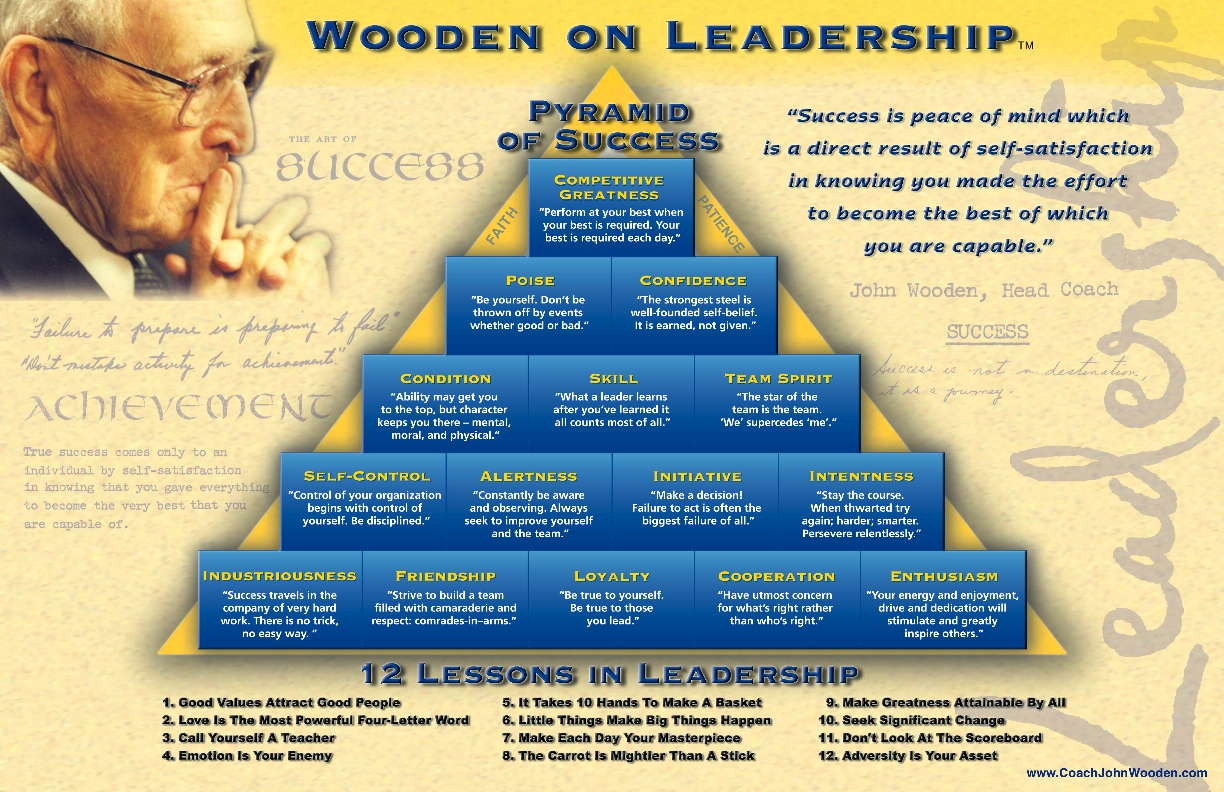
Ralph Labella and I coached Melrose's Lauren Joyce, who later attended Austin Prep and the United States Naval Academy. Her mother said that Lauren kept a laminated copy of the "Pyramid of Success" that we distributed in her gym bag. Lauren was a standout student and three sport captain -volleyball, basketball, and lacrosse player at AP.
Flanking the top of the Pyramid of Success are the words "FAITH" and "PATIENCE." From 1948 to 1975, Coach Wooden's teams won ten NCAA National Titles at UCLA. They won their first in his 16th season there. He understood 'patience'.
Patience implies waiting. "Wait your turn" or your time. Success comes not by waiting, but by working. We're lucky to have lamps with the twins having "bumped" the volleyball in the family room for so many years.
It is noteworthy that Benjamin Franklin's original 13 virtues, which he tracked in a memorandum book, did not include patience.
Think of "patience" as a component necessary for fire - not the oxygen of family and peer support, or the burning substrate, or the heat of desire, but part of the fuel needed to succeed.
Lagniappe. What are your volleyball affirmations, your self-talk?